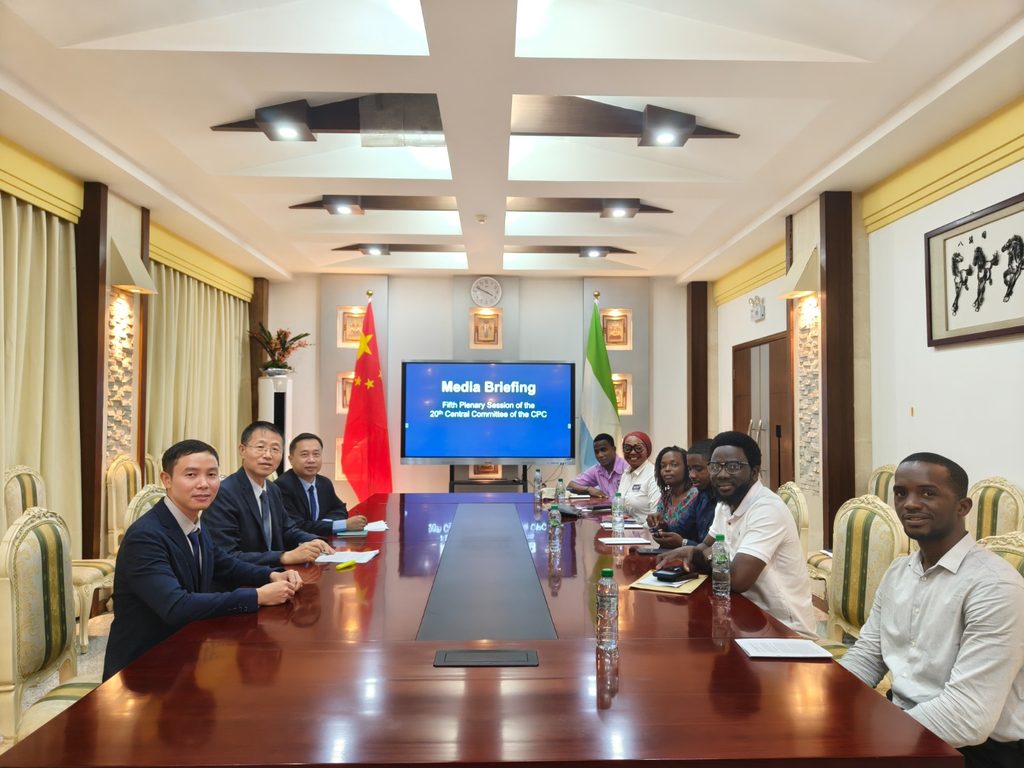
CHINA TAKES PARTY SELF-REFORM MESSAGE TO SIERRA LEONEAN MEDIA AS SALON DECIDE CEO PRAISES CPC GOVERNANCE DIRECTION:
By David K. Fengai
The Chinese Embassy in Freetown has engaged Sierra Leonean media institutions on China’s renewed commitment to strengthening internal Party discipline, fighting corruption and promoting responsible leadership, following the successful conclusion of the Fifth Plenary Session of the 20th Central Committee of the Communist Party of China (CPC).
The media briefing, held on Tuesday, November 17, 2026, at the Chinese Embassy in Freetown, provided an opportunity for journalists and media practitioners to understand the significance of the Plenary Session and China’s continued efforts to promote full and rigorous Party self-governance.
The engagement was presided over by Mr. Zhang Dianbin, Chargé d’Affaires ad interim of the Chinese Embassy in Sierra Leone, who warmly welcomed representatives of various media institutions and expressed appreciation for the longstanding friendship, cooperation and diplomatic relations between China and Sierra Leone.
In his opening remarks, Mr. Zhang highlighted the importance China attaches to its relationship with Sierra Leone, while reaffirming the country’s commitment to strengthening bilateral cooperation and mutual understanding through continuous engagement with the media and other stakeholders.
He subsequently provided an overview of the Fifth Plenary Session of the 20th CPC Central Committee, held in Beijing from October 26 to 29, 2026, under the leadership of the Political Bureau of the CPC Central Committee.
The session, under the leadership of General Secretary Xi Jinping, adopted the Resolution on Certain Major Issues Concerning Persevering with Full and Rigorous Party Self-Governance, reaffirming the Communist Party’s determination to continuously reform itself, strengthen institutional discipline and improve its capacity to serve the Chinese people.
Mr. Zhang explained that the Plenary Session carries an important message about leadership, accountability and the responsibility of political institutions to maintain high standards of integrity in governance.
Central to the reform agenda is the principle that discipline must apply to every Party member, regardless of position or influence. From senior leadership to grassroots membership, everyone is expected to operate within the framework of the Party Constitution, established rules and institutional supervision.
The Chinese Embassy representative further highlighted China’s determination to eliminate corruption through stronger accountability mechanisms, transparent institutions, effective punishment and the promotion of an integrity-driven political culture.
The reform initiative also places considerable emphasis on developing high-calibre officials who demonstrate loyalty, honesty, discipline and a strong commitment to serving the people, while contributing to Chinese modernization and high-quality national development.
Following the presentation, participating media houses were invited to share their perspectives on the CPC’s reform agenda and the broader lessons other countries could draw from China’s approach to Party self-governance.
Contributing to the discussion, the Managing Editor and Chief Executive Officer of SALON DECIDE NEWSPAPER, Mr. David K. Fengai, began by expressing profound appreciation to President Xi Jinping and the entire People’s Republic of China for the longstanding friendship, cooperation and support extended to Sierra Leone.
Mr. Fengai emphasized that, from his personal perspective, China had delivered a remarkable message to the international community about the importance of political parties and their officials placing public service, discipline and accountability at the centre of leadership.
He noted that the CPC’s commitment to examining its own structures, correcting weaknesses, strengthening discipline and ensuring that its officials remain accountable sends an important signal to political institutions across the world.
According to him, leadership should never be understood merely as the possession of political authority or the privilege of holding public office, but rather as a responsibility to serve the people, protect public confidence and deliver meaningful national development.
He further commended the Chinese Communist Party for what he described as a commendable direction towards institutional reform, stressing that political parties everywhere could draw valuable lessons from the importance of internal accountability and responsible leadership.
Mr. Fengai expressed confidence that the world could benefit from the principles being advanced through the CPC’s reform agenda, adding that he personally believes other political institutions would be encouraged to follow a similar positive direction in strengthening their internal governance and commitment to the people.
He also reiterated his appreciation for China’s continued engagement with Sierra Leonean media, describing the briefing as an important platform for knowledge-sharing, international understanding and constructive dialogue.
Other participating media institutions, including the Sierra Leone Broadcasting Corporation (SLBC), ECO Media, Radio 98.1 and Women in the Media, also expressed appreciation to the Chinese Embassy for organising the engagement and providing an opportunity to discuss China’s approach to political reform and governance.
Their contributions reflected appreciation for China’s willingness to share information about its governance priorities and engage Sierra Leonean journalists on issues of international importance.
The Fifth Plenary Session’s emphasis on full and rigorous Party self-governance goes beyond internal organisational administration. It highlights the relationship between institutional discipline, public trust, responsible leadership and a country’s long-term development ambitions.
By insisting that no Party member should stand above established rules and accountability mechanisms, China is reinforcing its position that sustainable leadership requires continuous self-examination, institutional improvement and a strong commitment to public responsibility.
For Sierra Leone and other developing countries, the discussion also provides an opportunity to reflect on how political institutions can strengthen internal democracy, promote integrity, discourage corruption and ensure that public office remains a platform for national service.
The November 17 media briefing therefore served not only as an explanation of an important political development in China but also as an opportunity for Sierra Leonean media practitioners to exchange perspectives on governance, leadership and institutional responsibility.
Ultimately, the message emerging from the Fifth Plenary Session is that the strength of a political party should not be measured solely by its political influence or ability to govern, but also by its willingness to discipline itself, confront its shortcomings and remain accountable to the people it serves.
China’s message is clear: A party that seeks to lead a nation must first demonstrate the courage to reform itself. Self-reform is strength, self-governance is leadership, and public service must remain the ultimate purpose of political authority.
By David K.Fengai,
SALON DECIDE NEWSPAPER
https://salonedecidenewspapersl.org